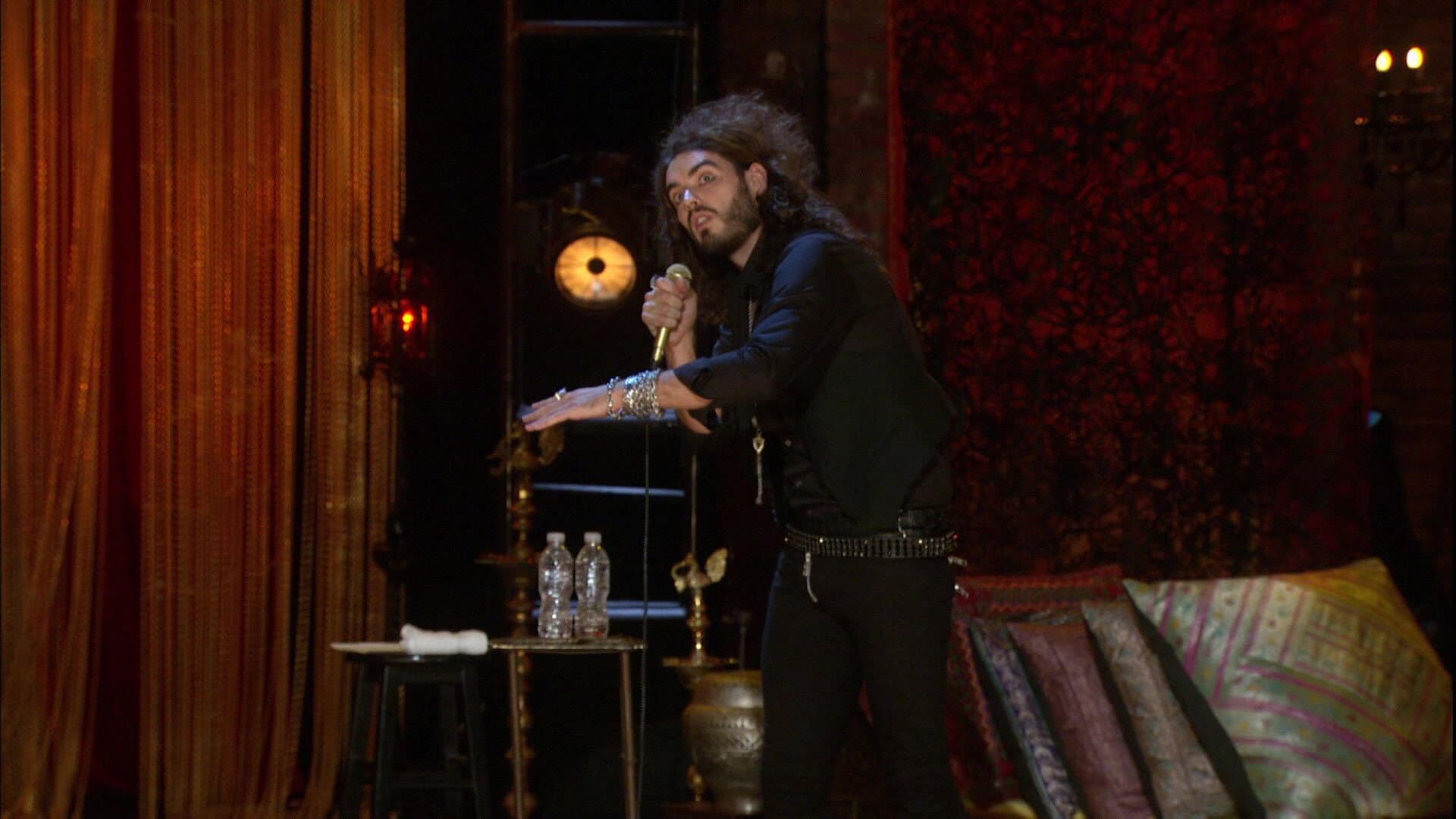
Russell Brand has always been a performer who refuses to sit still. The British comedian and actor first became a household name in the UK as a radio and television personality, then crossed the Atlantic and reinvented himself as a Hollywood fixture in the late 2000s. His filmography reads like a tour through the comedy tastes of an entire era - broad studio farces, Judd Apatow's improvisational universe, and a few animated blockbusters thrown in for good measure. Whether he was stealing scenes as a preening rock star or voicing a lovable villain, Brand built a movie career on the simple principle that restraint is for other people.
The Apatow Breakthrough
For many American audiences, Brand's introduction came in 2008's Forgetting Sarah Marshall, the Apatow-produced breakup comedy starring Jason Segel. Brand played Aldous Snow, a wildly successful British rock musician whose affected artistry and complete lack of self-awareness made him the perfect foil for Segel's heartbroken nice guy. It was a supporting role, but Brand's scene-stealing turn as the obliviously charismatic Aldous turned an exaggerated rock-star cliché into something genuinely funny. The performance landed so well that the character was spun off into 2010's Get Him to the Greek, which gave Aldous a messy, drug-fueled comeback arc and put Brand front and center as a leading man.
A Comedy Career Built on Big Swings
Around the same period, Brand became a familiar face in broad studio comedies. He appeared in 2008's Bedtime Stories opposite Adam Sandler, popped up in The Tempest and Despicable Me the following year, and starred in the 2011 remake of Arthur, stepping into the role famously originated by Dudley Moore. That same year he took a memorable turn as a flamboyant rocker in the ensemble comedy Rock of Ages. Then came Despicable Me - where Brand voiced Dr. Nefario, the gadget-making scientist and loyal right hand to Steve Carell's Gru. The animated franchise went on to become one of the biggest in film history, which means Brand's voice is technically part of one of the most successful movie properties of the past two decades.
None of these parts were meant to be quiet or subtle. Brand's screen persona - the long hair, the extravagant wardrobe, the rapid-fire delivery of absurdly confident one-liners - was a brand in itself, and Hollywood happily bought in. Still, a filmography built on big swings is a filmography built on risk, and not every swing connects. Some of Brand's leading-man vehicles, including Arthur, were widely considered disappointments, and his presence in a comedy came to signal a certain kind of chaotic energy rather than a guaranteed critical win. That's the trade-off for a performer whose entire appeal rests on being unmistakably, aggressively himself.
When the Spotlight Shifted
In the years that followed, Brand's career took an unusual turn. He stepped back from the studio-comedy treadmill and leaned harder into stand-up, documentary work, and eventually a new life as a commentator and podcast host. He also, for the record, married and later divorced pop superstar Katy Perry, a saga that briefly made him tabloid royalty in both the UK and the US. Through it all, Brand kept working steadily in live performance, but his days as a go-to Hollywood comic actor largely receded.
The Verdict on a Very Russell Brand Filmography
Looking back, Brand's movie run captures a specific cultural moment when studios were willing to hand big comedies to eccentric, personality-driven performers. His filmography lives in that space between the Apatow school of off-the-cuff comedy and the splashy, everything-goes studio production - and Despicable Me gives him a permanent asterisk as part of a billion-dollar animated franchise. Brand never aimed for the middle, and that's precisely what makes his Hollywood chapter worth revisiting. You may not always love the results, but you're never bored.
Source: The Economic Times